


September 16, 2026
Why Your Cooling Fan Relay Keeps Failing (And How to Fix It for Good)
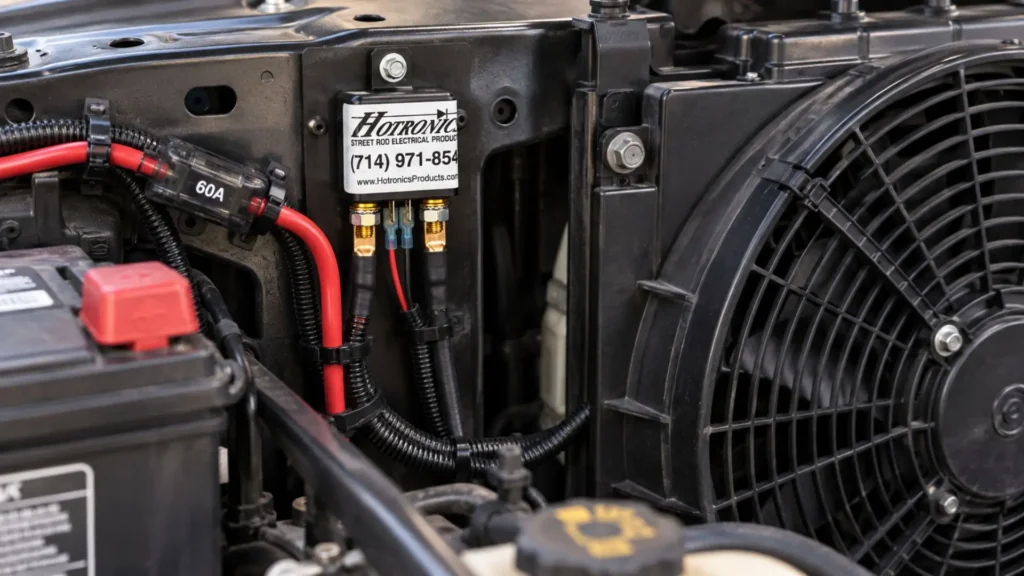
If you have replaced your electric fan relay more than once, you already know the pattern. The fan cuts out at idle, the relay clicks but nothing happens, or you pop the hood one day and find a connector that has partially melted into the harness. Most people assume the relay itself is bad and swap it for an identical part. Then it happens again.
The problem usually is not the relay brand. It is the amperage.
Electric Fans Draw More Than People Expect
A standard automotive relay is rated for 30 or 40 amps. That number looks generous on paper, but electric cooling fans do not pull a steady, predictable current. Most fan motors spike well above their running amperage for a split second at startup, especially on a hot restart when the motor is already warm. A fan that runs at 20 amps can easily draw 40 or more on that first surge.
Run that surge through a relay every single time your fan cycles on, and the internal contacts start to degrade. Each cycle pits the contact points a little more. Eventually you get resistance at the contacts, resistance turns into heat, and heat is what melts connectors and burns sockets. By the time you notice the damage, the relay has usually been failing quietly for weeks.
This is the same reason our switch kit for electric cooling fans is built to trigger a relay rather than switch the fan directly. A temperature switch is designed for low current signaling, not for carrying the full load of a fan motor. Send that load through the switch itself and you will burn it out fast, and probably take the connector with it.
Matching the Relay to the Load
The fix is not complicated. You need a relay rated well above your fan’s actual draw, with enough headroom to absorb that startup spike without stressing the contacts.
This is why we built the AR-75 ultra high amp relay. It carries a much higher continuous rating than the typical 30 or 40 amp relay most people default to, which gives it the margin to handle single fan setups and dual fan setups that pull real current without derating over time. If you are running two fans off one relay, or a high output fan on a performance build, undersizing here is the single most common reason people end up back at the parts counter.
Wiring size matters just as much as the relay rating. Undersized wire between the battery, the relay, and the fan creates voltage drop under load, which forces the motor to draw even more current to do the same work. That extra draw goes straight back through the relay contacts. If you are unsure what gauge to run, the SAE J1128 low voltage primary cable standard is the reference point automotive wiring is built around, and it is worth checking against before you commit to a wire size.
Pairing a Relay Upgrade With Your Temperature Switch
Once you have a relay sized correctly for the load, the rest of the circuit tends to run cooler and last longer. If you have not already read our post on choosing between a 180°F, 195°F, and 210°F temperature switch, it is worth a look alongside this one. The switch decides when the fan turns on. The relay decides whether that circuit survives the decision.
It is also common to pair a heavy duty relay with a cool down timer, so the fan keeps pulling heat off the engine for a set period after you shut the key off. We cover why that matters in our piece on the electric fan cool down delay module. Between a properly sized relay, a reliable temperature switch, and a cool down delay, you end up with a fan circuit that does its job without becoming a recurring repair.
Signs You Are Due for an Upgrade
A few warning signs are worth acting on before they turn into a bigger repair.
Your fan hesitates or clicks before it kicks on. That delay is often arcing at the relay contacts.
You have replaced the same relay more than once in a season. Same part, same failure, means the part is undersized for the job, not defective.
You find discoloration, a burnt smell, or a stiff, melted feel at the relay socket. That is heat damage, and it will only get worse from here.
You are running dual fans off a single stock relay. That setup is almost always underrated for the combined draw.
Final Thought
A relay is a small, inexpensive part, but it carries the full weight of your cooling fan every time it cycles. Sizing it correctly the first time saves you the recurring cost of replacement relays, melted connectors, and the diagnostic time spent chasing a problem that keeps coming back. Browse our full lineup in the Cooling Systems category if you want to look at the relay alongside compatible switches and timers for your setup.