


February 26, 2026
MBD-150 Battery Disconnect Switch Review & Specifications Guide
Every spring the phone rings with the same story. The car went under a cover in October, it looked perfect, and now it won’t even click. Somewhere in that wiring a clock, a radio memory or an aftermarket gauge sipped the battery flat over the winter.
You can pull the cable every time you park. You can bolt a big red knob on the battery. Or you can do what we designed the MBD-150 to do: flip a switch you’ve hidden somewhere only you know about, and walk away.
We didn’t set out to build just another cutoff. The first MBD-150 install guide, written back in 2003, put the goal plainly: a disconnect that can never run the battery down. A regular continuous-duty solenoid holds itself closed with current, so it becomes one more drain on the battery it’s supposed to protect. A latching one doesn’t. Give it a Quik Flip when you park, come back in a month or two, flip it back on and crank her up.
Quick answer: the MBD-150 is a latching solenoid battery disconnect for street rods and classic cars. It goes in the positive battery cable and is switched on and off by a small toggle you can hide anywhere in the car. Once it’s set, on or off, it uses no power at all, so it can’t drain your battery. It handles more than 100 amps continuous and a 600-amp cranking surge. Price: $145.
What the MBD-150 actually is
Most battery cutoffs are one of two things: a mechanical knob you turn by hand, or a solenoid that needs current flowing through its coil the whole time it’s engaged.
The MBD-150 is neither. It’s a latching relay solenoid. It needs a short pulse of current to move the latch one way or the other, and that’s it. Once the latch is in place, it stays there with no power. On or off, it never draws current. That’s the whole reason it exists: a battery disconnect that can’t become another battery drain.
You control it with a three-position mini toggle that’s spring-loaded to return to center. Flip it one way and the battery is connected. Flip it the other way and the starter has no juice, like somebody cut the cables. Take your finger off and the toggle snaps back to neutral, drawing nothing. You’ll hear the disconnect click over each time. We call it the Quik Flip, and that’s really all there is to using it.
MBD-150 specifications
| Spec | MBD-150 |
|---|---|
| Type | Latching relay solenoid battery disconnect |
| Control | 3-position momentary mini toggle, spring return to center |
| Continuous rating | Over 100 amps |
| Cranking surge | 600 amps for 30 seconds |
| Power draw once latched | None, on or off |
| Where it installs | Positive battery cable, between the battery and the starter solenoid |
| Mounting | Any position, on metal, wood or plastic; the base needs no ground |
| Toggle wiring | Blue to S, Yellow to I, Red into the T slot of the fuse holder, Black to body ground |
| Built-in fuse | Yes, on the hot side |
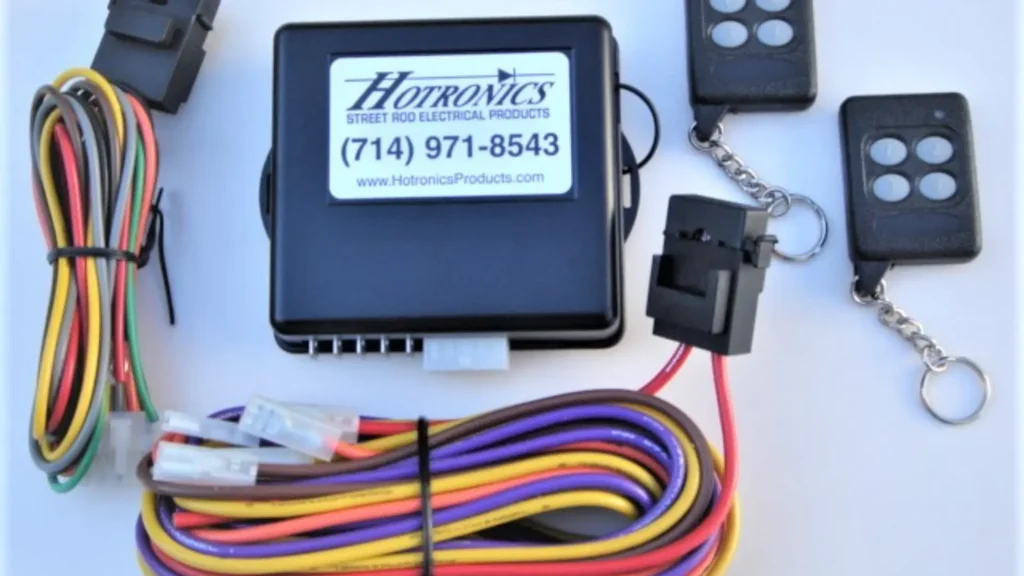
| Optional add-ons | RC-2a key fob remote, LED-F flashing reminder LED |
| Replacement parts | MBD-H harness, MBD-SO solenoid only |
| Price | $145 |
A word on that surge rating. A tired starter will stall at somewhere around 400 amps. The MBD-150 takes 600 for half a minute, so high-compression engines and high-torque starters have plenty of headroom. It won’t make a bad starter good. It’s just built tougher than it needs to be.
Why builders put one in
Storage without a dead battery. With the disconnect off, nothing in the car can pull from the battery. Depending on the battery’s condition, it can sit for months and still crank. Come back in spring, flip the toggle, and start it.
A car that won’t start for anyone else. With the MBD-150 off, the engine can’t be started. A thief has to find a toggle that could be under the dash lip, inside the console, behind a kick panel or anywhere else you chose. Add the RC-2a remote and you can switch it from a key fob instead.
Safe electrical work. Working on the dash or under the hood? One flip and the whole car is dead. When you’re done, one flip and it’s back. No wrenches on the battery terminal every time.
Protection against an electrical meltdown. If something shorts while the car is parked, there’s no battery power behind it. That matters most in cars with fresh, hand-built wiring.
A clean look. No big knob sticking out of the trunk or the battery box. Nothing under the hood tells anyone the car has a disconnect at all.
What it doesn’t do
The MBD-150 doesn’t replace your starter solenoid, and it doesn’t start the car. If you run a Ford-style starter solenoid now, keep it. The MBD-150 goes between that solenoid and the battery.
How to install the MBD-150
You’ll need basic hand tools, one new battery cable with ring eyes on both ends, and a clean ground point for the toggle. The full install guide with wiring chart is free to download.
- Disconnect the battery before you touch anything else.
- Pick a spot for the MBD-150 anywhere along the positive cable between the battery and the starter solenoid. It mounts in any position and to any material; the base doesn’t need to be grounded.
- Wire the hot side. Take the positive cable off the starter solenoid and connect it to the MBD-150 post with the fuse. That’s the hot side. Anything you never want switched off goes here too.
- Wire the cold side. Run the new cable from the MBD-150’s other post to the starter solenoid, where the old cable used to be.
- Move any extra wires. If other positive wires are bolted to the battery post, move them to the cold post. Otherwise they’ll stay live when the disconnect is off.
- Mount and wire the toggle. Hide it wherever suits you, ideally reachable from the driver’s seat. Route the wires through a grommet. Blue goes to S, Yellow goes to I, and Black goes to a clean body ground. Take care not to crush the back of the switch.
- Connect the red wire. Pull the MBD-150’s fuse, slide the red wire’s connector into the empty T slot of the fuse holder until it snaps in, then put the fuse back.
- Test it. Reconnect the battery. Flip the toggle one way and note the direction. Try to start the car. If it starts, shut it off and flip the toggle the other way. Now it shouldn’t start, and nothing in the car should have power.
Wire lengths can be extended. Solder or crimp every joint and insulate it. If you’d rather flip the toggle the other direction for “on”, just rotate the switch.
About clock and radio memory: you can wire a memory circuit to the hot side so it stays powered, but it will keep slowly draining the battery. If the car will sit for weeks, let the memory shut off with everything else, or give it its own small switch.
MBD-150 vs other ways to save a battery
| Option | Hidden? | Stops all drain? | Stops theft? | Hassle each time |
|---|---|---|---|---|
| Pull the negative cable | — | Yes | Yes | Wrench, hood up, every time |
| Knob-style cutoff on the battery | No | Yes | Only if you take the key | Reach the trunk or engine bay |
| Trickle charger | — | No, it replaces what’s drained | No | Needs a plug and a garage |
| MBD-150 ✓ | Yes, toggle goes anywhere | Yes, and draws nothing itself | Yes | One flip from the seat |
Questions we get about the MBD-150
Will the MBD-150 drain my battery?
No. It only uses current for the moment you flip the toggle. Latched on or off, it draws nothing.
Is it strong enough for a big starter?
It’s rated over 100 amps continuous and 600 amps for 30 seconds of cranking, well above what a typical starter pulls.
Do I still need my starter solenoid?
Yes. The MBD-150 only connects and disconnects the battery. It installs between the battery and the starter solenoid.
Does it have to be mounted on metal?
No. The base can go on metal, wood or plastic. Only the toggle’s black wire needs a metal ground.
Can I switch it with a key fob?
Yes, with the RC-2a remote, sold separately.
How do I remember it’s off?
Add the LED-F flashing LED. It’s on sale when bought with the MBD-150, and it doubles as an alarm-style warning light for anyone looking in.