


October 13, 2026
How to Convert Crank Windows to Power Windows Without Losing the Original Look
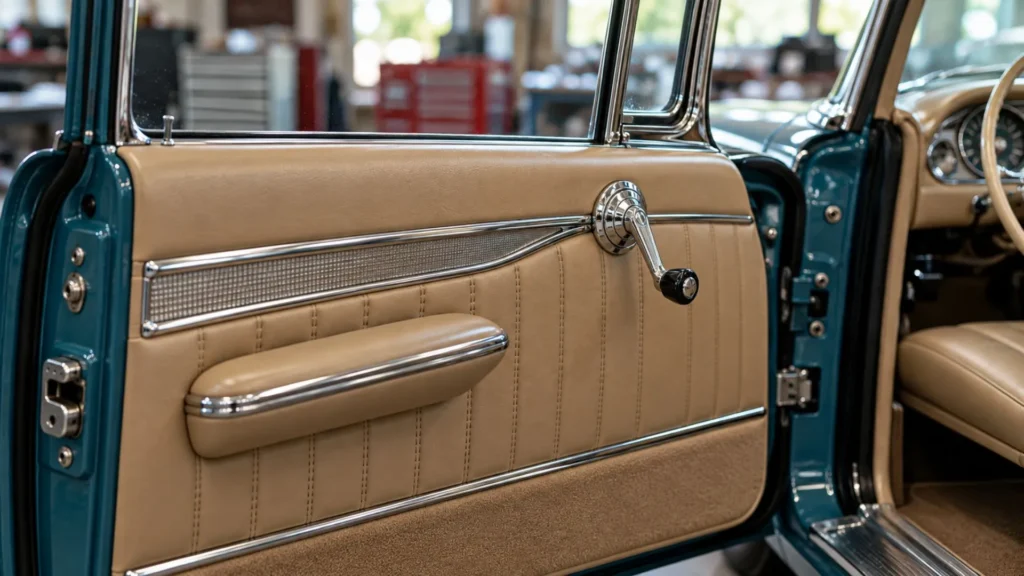
There’s a moment in almost every interior build where the owner stands next to the open door, holding a hole saw, and stops. Power windows are one of the nicest upgrades you can make to an old car. But the usual way to get them means cutting holes in a door panel for rocker switches, and on an original or freshly upholstered panel, that cut can’t be taken back.
We started making the electric window crank switch for exactly that builder. You get power windows, and the door panel looks like nothing changed. The original crank handle stays right where it’s always been. It just doesn’t crank anymore.
Quick answer: to convert crank windows to power, you need two things: an electric motor and regulator setup inside each door, and a switch to run it. If you want the interior to keep its original look, use a crank-handle switch like the Hotronics EWC. It mounts behind the door panel where the old crank shaft came through, and your stock handle goes back on it. Turn the handle slightly up and the window goes up; turn it slightly down and it goes down.
Every conversion has two halves
It helps to think about the job in two parts, because they’re bought and installed separately.
1. The motor side. This is the electric motor and regulator inside the door that actually moves the glass, plus the wiring that runs from the body into the door through the jamb. Kits are made for specific bodies and door styles, so buy the one built for your car.
2. The switch side. This is what the driver touches. It’s also the part people see, and the part that decides whether your interior still looks original. That’s the half we make.
Plan both halves before you cut, drill or upholster anything.
Your switch options, side by side
| Switch type | New holes in door panel? | Original crank handle stays? | Looks original? |
|---|---|---|---|
| Rocker switches in the door panel | Yes | No, the shaft hole gets plugged | No |
| Switch panel in a console or dash | No, but cuts the console or dash | No | No |
| Billet or custom switch on the panel | Yes | No | Custom look |
| EWC crank switch ✓ | No, uses the existing crank hole | Yes | Yes |
Rockers and switch panels are perfectly good choices for a full custom interior. The crank switch is for the car where you want the upgrade to be invisible.
How the crank switch works
The EWC sits behind the door panel on the same centerline where your manual crank shaft used to come through. Its shaft pokes out exactly where the old one did, and your original handle slides onto it.
- Turn about 18 degrees up and the window motor runs up. Turn about 18 degrees down and it runs down. Let go and it stops.
- Positive stops inside the switch mean a heavy-handed passenger can’t crank it past its travel and break it.
- Only 5/8 inch thick, so it fits in the shallow space behind most door panels.
- Handles window motors up to 15 amps.
- Works with straight or reverse polarity motors.
- Serviceable. The switching is done by a micro switch, and a replacement micro switch is available, so you’re not throwing the whole unit away years from now.
It’s made in the USA, it’s been featured on TV and in magazines, and it’s still the same design we came up with. There are copies around, so check the name on the box.
Which EWC fits your car?
The only real decision is the shaft, and it has to match your crank handles. Pull one handle off and look at the shaft it came off: a plain square, or a round shaft with fine teeth (a spline).
| Model | Shaft | Fits | Price |
|---|---|---|---|
| EWC-10 | 3/8 in. square | Cars with square-shaft crank handles | $110 |
| EWC-15 | Spline | ’50s-up GM passenger cars, ’68-up GM pickups | $120 |
| EWC-20 | Spline | Ford, early GM to 1950, GM pickups to ’67 | $120 |
| EWC-25 | Spline, 1/2 in. longer than EWC-20 | Same cars as EWC-20, when you need extra shaft length | $120 |
Not sure between the EWC-20 and EWC-25? Measure how far your door panel sits from the inner door skin where the crank comes through, then call us with that number and your car. We’d rather spend two minutes on the phone than have you order twice.
Before you install: four things to check
1. Make sure the glass moves freely by hand. Before any motor goes in, run each window up and down with the old crank. If it drags, binds or needs a shove at the top, fix the channels and felts first. A motor fighting a dragging window pulls more current and works harder. This matters most on chopped tops and one-piece glass conversions, where the channels are rarely perfectly lined up.
2. Check your motor’s current draw. The EWC handles motors up to 15 amps. Your motor kit’s paperwork should list its draw. If it’s higher, or you can’t find it, call us before you wire anything.
3. Plan the wire run through the door jamb. The wires have to flex every time the door opens. Use a proper door jamb loom or grommet, leave a gentle loop, and keep wires clear of the regulator’s moving arm inside the door. Pinched jamb wiring is one of the most common power window failures we hear about.
4. Protect every circuit. Feed the windows through a fuse or circuit breaker sized to your motor kit’s instructions, and use wire heavy enough for the run length. Solder or crimp and insulate every joint.
If a window runs the wrong way when you test it, don’t worry. The EWC works with either motor polarity; swapping the two motor leads reverses the direction.
The full EWC install guide can be downloaded from the product page.
While the door panels are off
Door panels only come off so many times before clips start breaking, so think about what else belongs in the door now:
- Power locks. The DLA-2 door lock actuator ($35 each) mounts inside the door alongside the window motor.
- Remote locking. The RES-2 remote lock and unlock kit handles two doors from a key fob.
- One-touch down on rocker-switched windows. If any window in the car uses a standard rocker switch, such as a rear or vent window, the OTC-1 Window Express ($102) gives it one-touch down. It works with polarity reversing motors and existing rocker switches, and it’s built to cope with windows that drag a little in their channels.
Questions we get about crank-handle power window switches
Can I keep my original window crank handles?
Yes. That’s the point of the EWC. Your stock handle goes back on the switch’s shaft, in the same place it always was.
Do I have to cut my door panels?
No new holes are needed. The switch uses the existing crank shaft hole.
Which EWC do I need?
It depends on your crank handle’s shaft. The EWC-10 has a 3/8 inch square shaft; the EWC-15 fits ’50s-up GM cars and ’68-up GM pickups; the EWC-20 and EWC-25 fit Ford, early GM to 1950 and GM pickups to ’67, with the EWC-25 being 1/2 inch longer.
Will it work with my window motors?
The EWC works with straight or reverse polarity motors drawing up to 15 amps.
Do the crank switches come with motors?
No. The EWC is the switch. Buy a motor and regulator kit made for your car, then use the EWC to control it.
What if a switch wears out?
The micro switch inside is replaceable, and we sell it separately.
Not sure what fits? Call the shop.
Tell us the year, make and model, what crank handles you have, and which motor kit you’re using. We’re in Anaheim, California, Monday to Saturday, 8 a.m. to 5 p.m., at 714-971-8543.
Shop EWC power window crank switches →