


August 13, 2026
Why Your Turn Signal Won’t Cancel Itself (And What That’s Really Telling You)
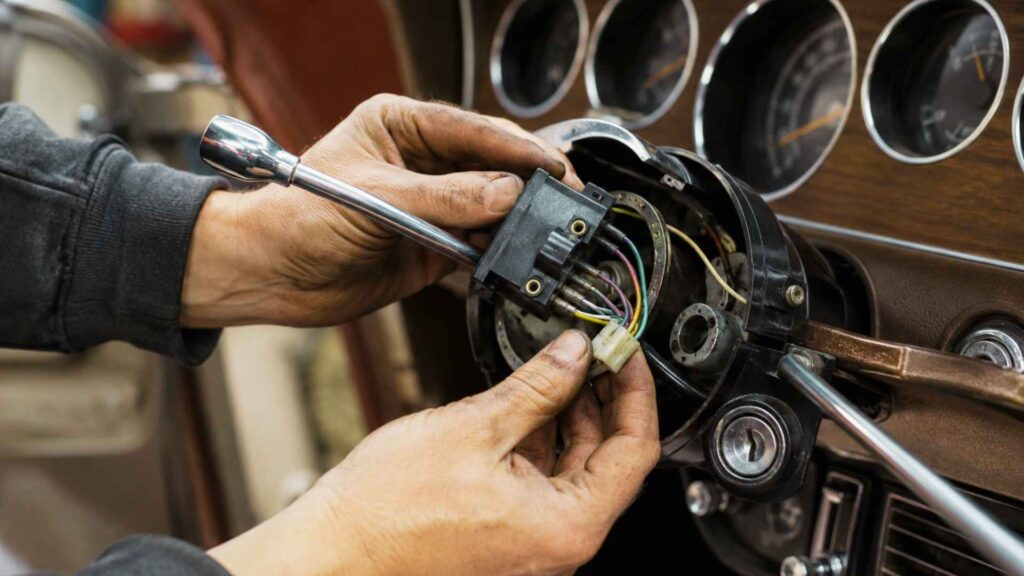
You make a turn, the wheel comes back through your hands, and on a modern car the signal just quietly shuts off. You do not think about it. On a lot of classic cars and hot rods, though, that little bit of automation never happens at all. You finish the turn, the arrow keeps blinking, and three lights and a tailgate comment later someone flags you down to let you know.
If that sounds familiar, you are not doing anything wrong. It is almost never a driving habit problem. It is a wiring and column problem, and it is one we get asked about often enough that we think it deserves its own explanation.
Why This Happens So Often in Classic Cars
On most factory vehicles, the steering column has a small plastic cancel cam attached to the wheel hub. As you turn the wheel back to center, that cam physically trips a lever inside the signal switch and shuts the blinker off. It is a purely mechanical solution, and it works fine as long as every part of that system matches.
The trouble starts when a car has been modified from its original configuration. This shows up in a few common ways:
- A tilt column or aftermarket column was swapped in without the matching cancel cam
- The steering wheel was changed to an aftermarket design that does not engage the factory cam
- The column was shortened, dropped, or relocated during a custom build
- A universal turn signal switch was installed that has no cancel mechanism built in at all
None of these are wiring mistakes in the traditional sense. The circuit itself usually works fine. What is missing is the mechanical piece that used to do the canceling for you, and once it is gone, the signal has no way to know the turn is finished.
It Is a Bigger Deal Than It Feels Like
A signal that will not cancel feels like a minor annoyance, but the safety research on this does not treat it that way. Improper turn signal use, including forgetting to switch it off after a lane change or turn, has been linked to more than two million accidents a year in a widely cited study from the Society of Automotive Engineers, a figure that outpaces crashes tied to distracted driving. A signal left on after a lane change tells the drivers around you the opposite of what you are actually doing, and on a car with a distinctive look that already draws attention at every light, it is an easy detail to get called out on.
There is a practical cost too. A stuck signal left on for even a short highway stretch adds unnecessary flasher cycles and current draw, and on a car with an older or marginal battery and charging setup, that kind of small parasitic load adds up faster than people expect.
What a Self-Canceling Turn Signal Module Actually Does
The fix is not to relearn how to drive. It is to put the canceling function back into the circuit electronically instead of mechanically. That is exactly what our SCTS-10 Self Canceling Turn Signal system was built for.
Instead of relying on a cam and a lever, the SCTS-10 uses timed circuitry to shut the signal off on its own. You get an adjustable run time from twenty seconds up to two minutes, so the module can be set to match how you actually drive rather than a fixed factory default. A quick second press of the switch cancels the signal manually at any point, which covers a normal lane change without waiting on the timer. Left and right sides cancel independently, and the brake circuit is kept separate from the turn signal circuit, so a brake light input does not interfere with signal operation or the other way around.
It also handles four-way hazard flashing on its own, uses a standard automotive flasher, and works with either bulbs or LEDs. Because it fits any twelve volt negative ground fuse panel, it does not require a specific column, a specific switch, or a rewire of the dash to install. That matters most for cars that have already been through a column swap or a full custom dash build, where matching an original mechanical cam is no longer realistic.
Signs Your Car Would Benefit From One
A few quick checks will tell you if this is worth addressing on your car:
- You regularly catch yourself manually flipping the signal lever back to center
- Your column or wheel is not the factory original for that chassis
- The car has a custom or tilt column installation
- You have had someone flag you down about a signal left on more than once
If any of that sounds like your car, the issue is almost certainly mechanical, not electrical in the traditional troubleshooting sense, and it is a straightforward one to correct.
Getting It Right the First Time
Before installing any self canceling module, it helps to confirm a few things about your current setup. Check whether your existing flasher is a standard automotive type or a specialty unit, since some LED conversions already require a no load flasher for other reasons. Take a look at how your turn signal switch is wired into the column and dash, particularly if the car has had prior electrical work done by more than one person over the years. And if you are already dealing with LED taillights that hyperflash, it is worth addressing that at the same time rather than solving one signal problem and running into another a week later.
We also recommend confirming your battery and charging system are in good shape before adding any new circuit, especially on a car that already shows signs of parasitic drain. Our MBD-150 battery disconnect switch guide covers how to check for that kind of drain and protect your battery between drives, which is a useful companion step if your electrical system has not had a full checkup in a while.
A turn signal that will not cancel itself is a small thing until it is not. It is also one of the more satisfying fixes to make, because the moment it is done, you stop thinking about it entirely, which is exactly how a good turn signal should behave.